Showing posts with label New Issue/Les nouveautés. Show all posts

Friday, October 10, 2014

[TAIWAN] New issue: 100th Anniversary of the Taipei Zoo Commemorative Issue

Date of issue: October 16, 2014

Established in 1914 in Yuanshan, Taipei Zoo is the oldest zoo in Taiwan. It relocated to Muzha in Wenshan area 72 years later. The year 2014 marks the zoo’s 100th anniversary. To commemorate this ocassion, Chunghwa Post is releasing a set of six stamps featuring protected wild animals. The designs follow:

1. Formosan Serow (5TWD): This serow is dark tan in color all over. The center of its nape is black. The underside of the chin, the jaw, and the throat are light tan. It has a short tail. Both the female and the male wear conical horns that stay with them lifelong.
2. Formosan Pangolin (5TWD): It earns its Chinese name for its armor shells and its preference to dig burrows. It has a conical head, a pointy mouth, small eyes, and thick eyelids. With the exception of its mouth, the cheeks, the chin, the throat, the belly, and the inside of its four legs, the animal is covered in taupe-colored shells. Though toothless, it has five claws on all of its four legs; its forelimbs are particularly strong.
3. Asian Elephant (10TWD): The Asian elephant is a majestic animal with four powerful legs, and dark gray coloring. Its tube-like, boneless trunk is an elongation of the upper lip and nose combined.
The trunk is built with flexible muscle tissues, and can be manipulated, extended and contracted at will. The elephant uses its trunk for drinking, grasping objects, picking up food, and watering with ease.
4. Formosan Black Bear (10TWD): The bear has black, coarse fur all over, with a tuft of white hair on its chin. On its chest is a distinctive, whitish "V" pattern. The bear is a subspecies endemic to Taiwan, and the largest land mammal on the island.
5. Bengal Tiger (12TWD): It has yellow or muster yellow coloring, and is covered with thin, black stripes; the stripes on its head are more densely distributed. Its belly is white. The back of its ears is black, spotted with white. The tiger has an excellent sense of hearing, razor-sharp teeth, and retractable shark claws. It is an apex predator in the forest, with stripes that offer exceptional disguise.
6. Giant Panda (12TWD): It has a pair of black eye patches, four strong limbs, and a thick black-and-white coat for protection in snowy winters. Its plump body allows him to survive on a bamboo diet, and a cool, damp weather. Its small black ears help him conserve energy. The design of this stamp features 4-month-old Yuan Zai snuggling to her mother Yuan Yuan.

Thursday, October 9, 2014

[DPRK(North Korea)] New Issue: Tok Islet of Korea

Notice: This "detail of stamp" provided by Korea Stamp Co.,, DPRK. The articles as follow does not represent this blog's the position.

Date of issue: August 22, 2014


Tok Islet has been an inseparable part of Korean teritory the world recognizes in view of history and international law.
Korean ancestors had already discovered Tok Islet before 500 AD and used it as a fishery zone.
Korean nation keeps numerous historical records of noble patriotic struggles of Korean people to defend The Tok Islet.

30 KPW: A geographical map of Tok Islet.


Friday, August 15, 2014

[DPRK(North Korea)] Past Issue: New Year Address


Date of issue: February 1, 2014

The stamps were issued to reflect the main spirit of then New year address delivered by Marshal Kim Jong Un, Supreme leader of the Workers' Party of Korea and Korean people, to greet the new year Juche 103(2014). 
The new year Juche 103(2014) is the year of grandiose struggle and of great changes in which a fierce wind of the fresh leap will be raised on all fronts of building a socialist thriving nation to usher in a heyday of Songun Korea.
The stamps show the will of the Korean army and people who would usher in a great heyday in the revolution and construction by quickening the heroic advance full of conviction and enthusiasm in victory in the hopeful new year.

10 KPW: Let us hold up the torch of innovation in the sectors of agriculture, construction and science and technology in the van!
10 KPW: Let us raise a fierce wind of innovation in all the sectors of national economy including the vanguard sectors and basic industrial sectors!
10 KPW: Let us make a big stride in the construction of culture including education!
30 KPW: Let us continue to channel great efforts to strengthening the country's defence capabilities! 
30 KPW: Let us further consolidate the political and ideological position of the Korean revolution! 
30 KPW: Let us make a new headway in this year's national reunification movement true to the behests of the President Kim II Sung and Chairman Kim Jong II


FDC

Monday, August 11, 2014

[DPRK(North Korea)] New Issue: Commemoration of the Day of Songun


Date of issue: August 25, 2014

The Day of Songun when the great leader Comrade Kim Jong II started Songun revolutionary leadership was a historic day that etched an important milestone in the history of building our revolutionary armed force and in the annals of our motherland together with the Day of Founding of the Korean People's Anny. 
On August 25 Juche 49(1960) Kim Jong Il gave on-the-spot guidance to Seoul Ryu Kyong Su Guards 105th Tank Division which was a historic event that declared the succession of the revolutionary cause of Songun and a fresh start of Songun leadership.
30 KPW stamp: Let us remain faithful to the Songun revolutionary leadership of the great Comrade Kim Jong Un!
50 KPW stamp (sheetlet): Leader Kim Jong II beam-ing at a rich diet of the soldiers
50 KPW stamp (sheetlet): Supreme Commander Kim Jong Un inspecting the units of 4th corps com-mand of the KPA.
FDC


Monday, August 4, 2014

[DPRK(North Korea)]New Issue: WWF - Red-crowned crane


Date of issue: August 5,2014

10KPW, 30KPW, 50KPW, 110KPW: Red-crowned crane

FDC
stamp booklet

Postcard and Aerogramme
small sheet and full sheet

PS: If you want stamps and items as up, please contact: kiahsutw@gmail.com

Sunday, August 3, 2014

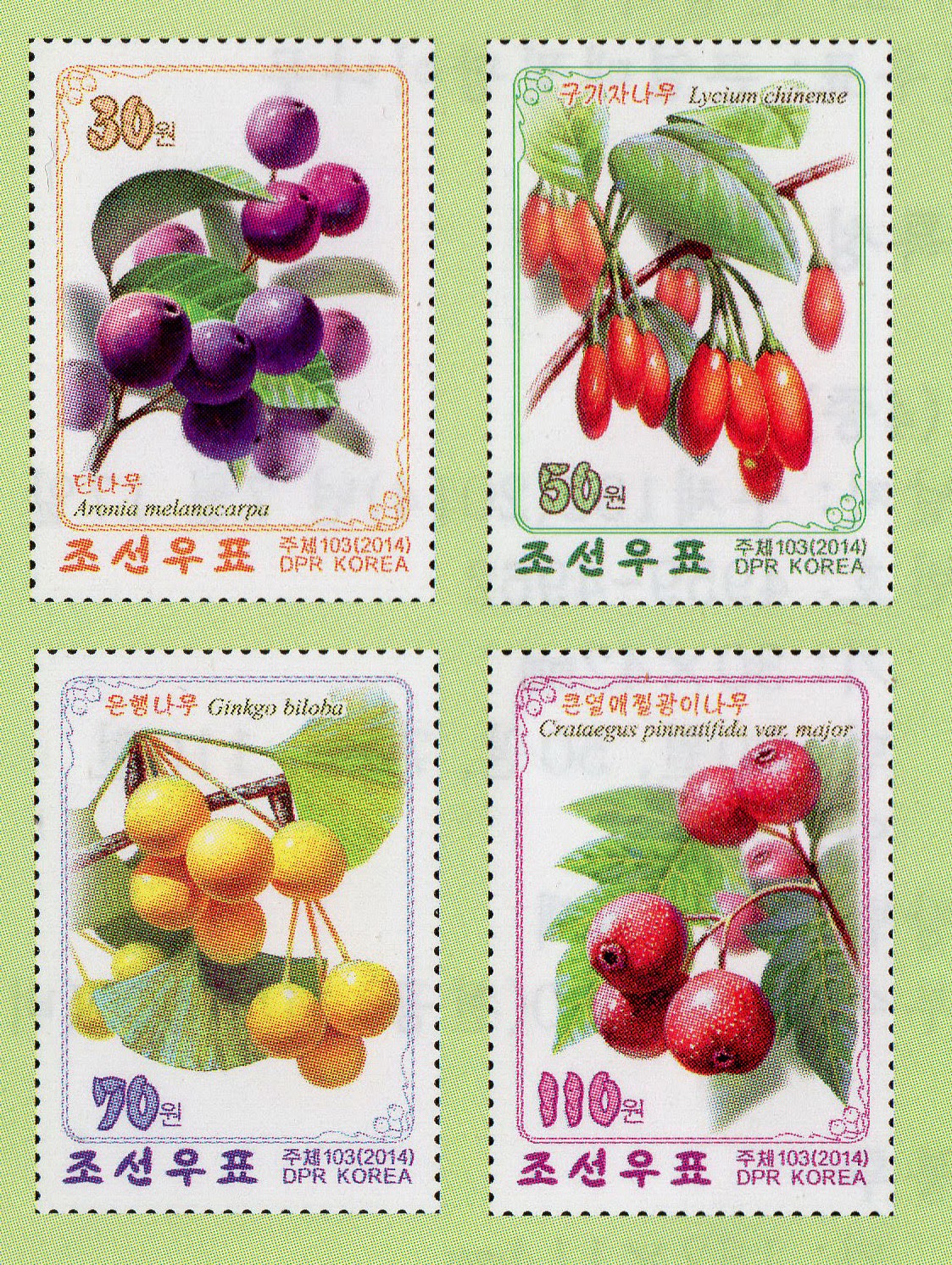
[DPRK(North Korea)] New Issue: Medicinal Plants


Issue Date: July 17, 2014


30KPW: Aronia melanocarpa

50KPW: Lycium chinense
70KPW: Ginkgo biloba
110KPW: Crataegus pinnatifida var. major


FDC

                                                                               Small Sheet

Post card & Aerogramme

PS: If you want buy stamps or items as up, please contact: kiahsutw@gmail.com

Monday, July 28, 2014

[TAIWAN] New Issue: National Taiwan Library 100th Anniversary Commemorative Issue


Date of issue: August 9, 2014

The predecessor of the National Taiwan Library was the Taiwan Governor-general’s Office Library established in 1914, during the Japanese Occupation Period. It was rechristened several times: the Taiwan Province Administrative Governor Library; the Taiwan Province Taipei Library; the National Central Library Taiwan Branch; and finally, the National Taiwan Library, the name and the reorganization of which were approved by the Executive Yuan on January 1, 2013. It is the oldest public library in Taiwan. 

The Library houses a remarkable cumulation of Taiwan’s historic records that dates back to the Japanese Occupation Period. The Library is revered for its rich book collection and readily available resources for readers; it aims at upgrading library serviceableness and social education. In addition to the pioneering "Children’s Reading Room," "BookMobile," and "Book Restoration Services," the Library also works to improve its versatility development by inaugurating "the Information Center for the Visually Impaired," "Taiwan Library Infirmary," and "Taiwan Study Research Center." The Library also keeps abreast with the high-tech development to build a digital library, a testament to the spirit of contemporary-mindedness.

In celebrating the Library’s 100th anniversary, Chunghwa Post is issuing a NT$12 stamp, with “Taiwan Governor-general’s Office Library" – its predecessor, and the contemporary "National Taiwan Library" as the theme. 

Wednesday, July 16, 2014

[TAIWAN]New Stamp: Alpine Lakes of Taiwan Postage Stamps (I)


Date of issue: July 17, 2014
To heighten recognition of the beauty of Taiwan’s alpine lakes and further encourage our fellow citizens to treasure natural ecological resources, Chunghwa Post has planned a series of stamps on the motif. The first set features four lakes located at a higher altitude. The designs follow:
1. Cuichi Pond (NT$5): Situated in Miaoli County, Cuichi Pond has the highest altitude - about 3,520 meters - of any lakes in Taiwan. Its lake water never runs dry at anytime of the year. Even in the dead of winter, the water does not freeze over in whole. 
2. Tunlu Pond (NT$5): The lake sits in Nantou County, abutting upon Hualian County at an altitude about 2,840 meters. The lake was once the habitat of herds of deer. It brims with the infusion of surface and underground waters all year round. Oval-shaped, the lake is a proverbial mirror huddled by verdant mountain valleys.
3. Qicai Lake (NT$10): The lake is located in Hualien County at an altitude about 2,890 meters. Mountaineers were charmed by the reflection of prismatic colors as sunrise rose above the lake, thus its name. Deer herds were sighted in earlier years, the lake therefore is also known as "Luchi (Deer Pond)." 
4. Jiaming Lake (NT$12): Seated in Taitung County, the lake sits on the second-highest elevation – about 3,310 meters - of any lakes in Taiwan. Jiaming Lake is reputed as "the sapphire that God left in the world of mortals" and "the Tear of an Angel."

Saturday, May 19, 2012

New Issue: Owls of Taiwan Postage Stamps (Issue of 2012)/Les nouveautés: Les hibous du Taiwan (l'Édition de 2012)


Date of Issue: 6. 6. 2012

1. Asio flammeus (NT$5): About 37-42 centimeters in length. It has a pale yellow facial disc, dark circles around the eyes and small ear-tufts. Its backside plumage is yellowish brown with vertical black streaks, whereas its chest and abdomen are pale yellow with vertical brown streaks. In Taiwan this is a migratory bird that overwinters on the island, but it is not common. Its habitat includes open agricultural lands and grasslands.
2. Otus spilocephalus (NT$5): About 15-17 centimeters in length. It has a yellowish brown facial disc, a yellow beak and prominent ear-tufts. Its crown feathers are light brown with black spots, and it has prominent milk white circles on its neck. The body is mostly light brown in color, with an off-white belly that has a dense array of light brown stripes. Its range stretches from low-altitude to high-altitude areas, and it is found mostly in forest environments.
3. Strix leptogrammica (NT$10): About 50-58 centimeters in length. Its facial disc is black around the eyes and gradually fades to white and then darkens to reddish-brown toward the edges. It lacks ear-tufts. There is a dark reddish-brown coloration from its head to backside. Its neck and throat are white, and the abdomen is light brown and covered with dark brown fine horizontal bars. It inhabits at the edge of woodlands or in the glades of mixed forests.
4. Ninox scutulata (NT$25): About 22-28 centimeters in length. It has a round head and lacks both ear-tufts and prominent facial disc. Its plumage is largely dark brown, with a belly that is beige with randomly scattered dark brown spots. Its population in Taiwan includes both migratory and non-migratory groups. It lives primarily in low- and mid-elevation mountainous regions.

Friday, March 2, 2012

New issue: Long-horned Beetles Postage Stamps (III)/Les nouveautés: Timbre-poste de longicornes(III)


Chunghwa Post previously issued two sets of stamps on long-horned beetles on May 21, 2010 and January 26, 2011 respectively. This third set of four stamps, featuring four kinds of them which are endemic to Taiwan, Leptura formosomontana formosomontana, Pyrestes curticornis, Anaglyptus meridionalis, and Anoplophora albopicta, will be released on March 9, 2012. The designs follow:
1. Leptura formosomontana formosomontana (NT$7): This beetle has a black body with eight yellow markings on its elytra. Unlike most males of the genus, the end of the abdomen of this species is shorter than its elytra. It is found in broad-leaved forests and coniferous broad-leaved mixed forests at around 2,000 meters above sea level. An adult is typically about 1.6 to 1.9 centimeters long.
2. Pyrestes curticornis (NT$12): This beetle has a red body and a pair of dark-red flat and jagged antennae. Some individuals in this species have black antennae. The surface of its elytra is covered with stippling and fine red hair. The species is found in broad-leaved forests between the coastal plain and 1,400 meters above sea level. An adult is typically about 1.5 to 1.8 centimeters long.
3. Anaglyptus meridionalis (NT$15): This beetle has a bright red body. Its pronotum and elytra are covered with many black markings encircled by fine golden yellow and white hair. Its antennae are black overall, but the base of each segment is white. The species is found in broad-leaved forests and coniferous broad-leaved mixed forests between 1,200 and 2,400 meters above sea level. An adult is typically about 1.5 to 1.8 centimeters long.
4. Anoplophora albopicta (NT$20): This large beetle has a black body with a violet-blue or violet-green metallic sheen. Its head, antennae, and elytra are all black, but the base of each of its antennae segments is white. There are some sharp spurs on the outer edges of its prothorax. The surfaces of its elytra are smooth and dotted with white spots. The species is found in broad-leaved forests between the coastal plain and 2,000 meters above sea level. An adult is typically about 4.3 to 5.7 centimeters long.

Thursday, January 12, 2012

New Issue: Valentine’s Day Postage Stamps (Issue of 2012)/Les nouveautés: Saint-Valentin timbres (édition de 2012)


Valentine’s Day on February 14 is a much-celebrated holiday among young people. To encourage people to express their love through letters, Chunghwa Post is issuing another set of two stamps and a souvenir sheet (Issue of 2012) with roses as motifs. The designs follow:
1. NT$12 stamp: A pink rose symbolizes first love and courting, as well as friendliness and a graceful upbringing. This stamp features a pink rose in full bloom to convey unrestrained passion.
2. NT$25 stamp: An orange rose bud reveals the reticence of first love. The vignette of this stamp brings warmth and joy to one’s heart.
3. Souvenir sheet: Within the heart-shaped stamp are two pale orange roses which signify mutual love and affection. The pink background along with the wordings “Happy Valentine’s Day” offers blessings to all of the world’s lovers.
The two stamps are designed as a se-tenant gutter pair. Embossing and spot varnish techniques are employed in printing. The gutter, featuring two hearts shot through with Cupid’s arrow, symbolizes mutual love. A six-color tag with another two additional marks indicating embossing and varnishing effects are printed on marginal inscription. The souvenir sheet is printed in scented ink—a first for Chunghwa Post.

Friday, June 10, 2011

New Issue: Owls of Taiwan/Les nouveautés: Owls de Taiwan

Owls (Order Strigiformes) are known as “cat head hawks” in Chinese because their flat faces give them a catlike appearance. Most owls are nocturnal and prey on insects, small birds and mammals. Currently, there are 12 species of owls in Taiwan, all of which are listed as protected species. To increase public understanding and raise awareness about the issues of wildlife conservation, Chunghwa Post has planned a set of four stamps featuring owls of Taiwan. The designs follow: 

1. Asio otus (TWD5):
About 35 to 40 centimeters long, it has a light yellowish brown facial disc and long ear-tufts. Its upperparts are grayish white and light yellowish brown with vertical blackish brown streaks. Its belly is yellowish brown to creamy white in color, with dark brown vertical streaks and fine horizontal bars. This rarely seen migratory bird overwinters in Taiwan. It prefers thin broad-leaved and coniferous forests.

2. Otus sunia (TWD5): About 15 to 18 centimeters in length, its inconspicuous facial disc is dark brown with a touch of mottled gray. It has ear-tufts. Its upperparts are largely dark brown with fine black vertical streaks. Its foreneck and breast are light yellowish brown with subtle dark brown vertical streaks and fine horizontal bars. There are two types—one reddish and the other grayish brown. A transient bird species in Taiwan, it only occasionally winters.

3. Strix aluco (TWD10):
About 35 to 40 centimeters long, its facial disc has a prominent black ring, giving its face the appearance of a halved apple. It has no ear-tuft. Its crown and hindneck are dark brown and mottled with black spots. Its underparts are yellowish brown with prominent blackish brown vertical streaks and fine horizontal bars. Mainly found in mid- to high-elevation broad-leaved or coniferous forests, it is especially fond of higher elevation coniferous forests.

4. Glaucidium brodiei (TWD25): About 15 centimeters in length, its head is small and rounded with no ear-tuft. Its upperparts are brown and its crown is a bit grayer with small white spots and larger creamy yellow spots. Its belly is white, with irregular dark brown vertical streaks along the sides. It can often be found resting in open woodlands or the forest’s edge. It is one of a few owls that are active both during the day and at night.

Thursday, April 28, 2011

New Issue: Alpine Flowers Postage Stamps

Taiwan is a mountainous island, with more than 200 mountains above 3,000 meters. With the wide range of vertical climatic zones on these mountains—from tropical and subtropical to temperate and cold—come some very diverse forests. Alpine plants grow in areas 3,000 meters above sea level. Constantly exposed to strong ultraviolet radiation, the blooms of these plants are brilliantly colorful. To introduce the beauty of Taiwan’s alpine flowers, Chunghwa Post is issuing a set of four stamps on these flowers. The designs follow:
1. Gentiana scabrida var. punctulata (NT$5): The plant can be found in open meadows and gravelly slopes in high elevation areas of the Central Mountain Range. Each branch typically produces one or two (and occasionally three) terminal flowers. The blooms have yellow campanulate calyx and corolla, with black spots at the base of the petals. Though small, when a colony of these colorful exquisite flowers is in full bloom, the sight is simply breathtaking.
2. Euphrasia transmorrisonensis (NT$5): The plant can be found at high elevations. Its Chinese name literally means “millet grass,” either because its small seeds resemble millet or the two yellow marks on the flower’s lip resemble millet. Its flowers are arranged in racemes, with very short pedicels. Each of its tiny delicate white flowers has four tubular or campanulate sepals and a smidgen of yellow on its corolla.
3. Clematis montana (NT$10): The plant can be found creeping in meadows or scrambling over shrubs on the sunny side of mountains at high elevations. The elegant white flower’s four large petal-like surfaces are actually its white sepals. The pale yellow filaments in the center of its blossoms are its stamen and pistil.
4. Cypripedium formosanum (NT$10): The plant can be found in moist forests on high elevation mountains. Its flowers are borne singly. The ovate lanceolate upper sepals of this showy flower are shell pink with pink veins. Bees enter through the opening of its bulging pouch-shaped labellum to carry out the task of pollination. In Chinese, the plant is nicknamed “umbrella” because its flower is shaped like one. And because its labellum resembles a slipper, the plant is also called Japanese lady’s slipper and Formosa lady’s slipper.

Thursday, March 3, 2011

New Issue: Taiwan Butterflies Postage Stamps (Issue of 2011)/Les nouveautés: Les Papillons de Taiwan (l'Édition de 2011)


Date of Issue: 8.4.2011

Because of its richly varied geography and its location straddling the tropics and subtropics, Taiwan has a great number of butterflies with rich species diversity. To call public attention to the importance of ecological conservation, Chunghwa Post previously issued a set of stamps on Taiwan butterflies on June 25, 2009, and it is now following up with a souvenir sheet (Issue of 2011), consisting of four stamps, featuring Euploea butterflies. The souvenir sheet, following the format of its forerunner of 2009, is printed in the shape of a butterfly, with a butterfly-shaped cutout on each stamp. The designs follow:

1. Euploea eunice hobsoni (Butler) (NT$5): This butterfly has dark brown forewings with an iridescent blue shimmer. There are some pale blue gray markings on the submarginal areas of each of its wings and at the center of its forewings.

2. Euploea sylvester swinhoei Wallace Moore (NT$5): The upper surfaces of the forewings of this dark brown butterfly have an iridescent blue shimmer near the apex and light blue spots along the outer edges of its cells. There are three pale blue gray spots at the center of the underside of its forewings.

3. Euploea tulliolus koxinga Fruhstorfer (NT$12): This dark brown butterfly has iridescent blue forewings. There are rows of white markings in the submarginal areas of the upper surfaces of each of its wings. The undersides of its wings are paler in color, with white markings at the center of its forewings and also in positions that correspond to the white spots on its upper surfaces.

4. Euploea mulciber barsine Fruhstorfer (NT$12): The male has a large violescent patch with some scattered tiny white spots near the apex of its forewings. The female has white scattered spots near the apex and white streaks on the inner edges of the forewings and the cells of the hind wings.

New Issue: Fishes of Taiwan Postage Stamps (I)/Les nouveautés: poisson du Taiwan (I)


Date of Issue:10.3.2011

The native freshwater fish of Taiwan’s rivers, lakes, and estuaries comprise the most diverse group of vertebrates within the island’s terrestrial ecosystem. Chunghwa Post has planned a series of postage stamps to introduce the beauty of Taiwan’s freshwater fishes. The first set of the series features Taiwan endemic fishes: Candidia barbatus, Opsariichthys pachycephalus, Spinibarbus hollandi, and Squalidus banarescui. The designs follow:

1. Candidia barbatus (NT$5): This silver white fish has an obvious deep blue lateral stripe extending from its gill cover to the base of its caudal fin. It typically measures about 6 to 12 centimeters long, but large examples can sometimes reach 20 centimeters. It is commonly seen in the upper stretches of rivers and their branches in western Taiwan. As a result of human introduction in recent years, it can be found in the rivers of the Hualien and Taitung.

2. Opsariichthys pachycephalus (NT$5): An adult male has some ten blue-green vertical streaks on the sides of its body and displays nuptial coloration in the area below its gill covers as well as at its pelvic, pectoral, and anal fins. Vigorous and ferocious, the species’ strong predatory characteristics make it a popular target for stream fishing. It typically measures about 8 to 15 centimeters long, but large examples can reach 20 centimeters. It is commonly seen in the rivers of western Taiwan.

3. Spinibarbus hollandi (NT$12): The fish has a medium-to-large mouth aperture and two pairs of barbels. The back of its body is slate gray and its sides are silver white. This large carp typically measures about 20 to 40 centimeters long. The largest examples can reach 60 centimeters in length. The stamp features a medium-sized adult. It can be found in the middle stretches of rivers in southern and eastern Taiwan.

4. Squalidus banarescui (NT$25): This fish is slightly transparent, with a black and gold lateral line on the sides of its body. There is a black marking that resembles the Chinese character for eight “八” on each of its lateral line scales. This small carp measures about 8 to 10 centimeters long. It can only be found in relatively deep and slow and slightly muddy rivers in central Taiwan.

Wednesday, January 19, 2011

New Issue:Valentine's Day Postage Stamps (Issue of 2011)/Les nouveautés:Les Timbres de Saint-Valentin (l'Édition de 2011)


Young people in Taiwan now widely celebrate western Valentine’s Day on February 14. Looking to attract the younger generations to stamp collecting as well as to encourage letter writing, Chunghwa Post is releasing another set of two Valentine’s Day stamps (Issue of 2011), which feature messages of love. The first in this series of stamp sets was issued on February 6, 2007.

The concept behind the design of this set of stamps is the code of true love, which Chunghwa Post first ever makes use of QR code (quick response code) technology. QR code can store more information than regular barcode. To decode the hidden message, users only have to take a picture of the QR code with a mobile phone camera that can take images of over 300,000 pixels, and the decode software in the phone will read the message and display it on the screen.

The design of the stamp features a heart formed by a row of perforations, as well as images of roses, presents, hearts, and the word “LOVE” created from pixels. Through the interaction between the sender and the receiver, these stamps convey love and heighten the romantic atmosphere of Valentine’s Day. The message of the code is “Happy Valentine’s Day” for the NT$5 stamp and “I Love You” for the NT$25 stamp.

Saturday, January 15, 2011

(TAIWAN)New Issue: Long-horned Beetles Postage Stamps(II)/Les nouveautés: Timbres des Cerambycidae(II)


Date of Issue: 26.01.2011

Previously issued a set of stamps on long-horned beetles on May 21, 2010, this Post is following up with a second set of four stamps, featuring Aeolesthes oenochrous, Doliops similis, Thermistis taiwanensis, and Dorysthenes pici. The designs follow:

1. Aeolesthes oenochrous (NT$1.00): Commonly known as the Wu-she blood-spotted long-horned beetle in English, the body of this large beetle is densely covered with shiny red hairs. The last three segments of the male’s back-sweeping antennae extend beyond the tips of its elytra, whereas the female’s antennae are shorter than its body. It is found in broad-leaved forests between 600 and 1,500 meters above sea level in mid and northern Taiwan, as well as in China.

2. Doliops similis (NT$3.50): This species is a mimic of the hard-shelled Pachyrrhynchus. This attractive beetle has a black body covered with iridescent blue markings. It has large femurs and tarsi. An endemic species of Taiwan, it can only be found on Orchid Island.

3. Thermistis taiwanensis (NT$10.00): This beetle has a black body, with a yellow blotch on the front of its head, a yellow band on each side of its pronotum, and tubercles on the outer edges of the pronotum. Its elytra are black with yellow bands. Its antennae are black. Its femurs are yellow and the remainder of its legs and claws are black. Endemic to Taiwan, this species is found in broad-leaved forests between 1,200 and 1,500 meters above sea level.

4. Dorysthenes pici (NT$32.00): It has a dark brown, almost black body and a very developed mandible. There are two serrations on its pronotal edge. The male’s antennae extend over half way down its elytra, whereas the female’s only reach the length of one third of its elytra. Endemic to Taiwan, the species is found in broad-leaved forests between 300 and 1,400 meters above sea level in northern Taiwan.

Friday, July 2, 2010

New Issue:Lighthouses Postage Stamps (Issue of 2010)/Les nouveautés:Les Timbres de Phares (l'Édition de 2010)


Date of issue: July 28, 2010

Chunghwa Post first issued a set of stamps on lighthouses in 1989, and now it is following up with another set of four stamps on the topic, featuring the following lighthouses:

1. The Chilung Tao Lighthouse (NT$5): The lighthouse is located at the highest point on Chilung Tao, off Keelung Harbor. Built in 1980, this octagon-shaped concrete tower, with a black-and-white vertical-striped daymark, uses air batteries for electricity. In 1998, the lighthouse switched to solar power. In 2006, wind power was added as a secondary power source. The lighthouse has a nominal range of 13.8 nautical miles.

2. The Wenkan Tui Lighthouse (NT$5): Built in 1914, this skeletal steel frame light tower is located on Waisanding Sandbar off Kouhu Township, Yunlin County. In 1974, due to sandbar shift, the lighthouse was rebuilt and placed in a new location nearby. The new structure is a square tapered steel frame tower, using a fourth-order AC light. In 2006, because of sandbar shift, the lighthouse was moved once again to present location, and a radar beacon pole was added. The lighthouse has a nominal range of 13.1 nautical miles.

3. The Paisha Chia Lighthouse (NT$10): Built in 1901, this round brick light tower is located in Guanyin Township, Taoyuan County. In 1956, the lighthouse was equipped with a third-order revolving lens light, producing one flash every 20 seconds, alternating between white and red lights. The white and red lights have a luminous intensity of one million and 310,000 candlepower respectively. In 2002 the Taoyuan County Government designated the lighthouse as a county monument. The nominal range of the red light is 22.6 nautical miles, and the range of the white light is 25.7 nautical miles.

4. The Liuchiu Yu Lighthouse (NT$25): Built in 1929, this round light tower is located at the highest point on the south-east coast of Liuchiu Yu off Pingtung County. In 1952, the lighthouse was equipped with a fifth-order acetylene flashing light. In 1980, the light was replaced by an AC light, which has a luminous intensity of 10,000 candlepower. The lighthouse has a nominal range of 14.3 nautical miles.

Wednesday, June 30, 2010

New Issue: Chinese Classic Novel “Journey to the West” Postage Stamps (Issue of 2010)/Les nouveautés:Le Roman Classique chinois “Le Voyage en Occident” les Timbres (l'Édition de 2010)


Date of Issue: July 7, 2010

In order to present the beauty of Chinese classic literature, Chunghwa Post is following up with a new set of four stamps on Chinese classic novel “Journey to the Wes,t” “Complete Enlightenment,” “Sun Wukong Wreaks Havoc in Heaven,” “Dreaming of Beheading the Jing River Dragon King,” and “Stealing the Ginseng Fruits.” The designs follow:

1. Complete Enlightenment (NT$ 5): The monkey king of Mt. Huaguo in the Water Curtain Cave, desiring immortality, made off to the Three Star Cave to study under the Buddhist Patriarch Subodhi, who gave him the name Sun Wukong, and from whom he learned secrets of magic. Later, because Sun would recklessly show off his magic, Subodhi renounced
him as a student. Furthermore, Subodhi gave him a pointer: “Whence one comes, one returns.”

2. Sun Wukong Wreaks Havoc in Heaven (NT$5): The Jade Emperor conveyed on Sun Wukong the title “Great Sage Equal of Heaven,” and sent him off to administer the garden of Queen Mother of the West’s peaches of immortality. Sun stole and ate some peaches, pills of immortality and wine prepared for Heaven’s Peach Festival. The Jade Emperor dispatched his forces to capture him and the monkey was imprisoned in Mt. Wuhang by Tathagata.

3. Dreaming of Beheading the Jing River Dragon King (NT$12): The Jing River Dragon King disobeyed the Jade Emperor’s directive to create rain. Consequently, the emperor sent Wei Zheng to behead the Dragon King, and the Dragon King appeared in Emperor Tang Taizong’s dream to ask for help. To divert Wei Zheng’s attention, Emperor Tang Taizong invited him to his palace to discuss affairs of state and then play chess. During the game Wei Zheng dozed off, at which time his spirit left his body to behead the dragon.

4. Stealing the Ginseng Fruits (NT$25): The Ginseng fruit was a great treasure of Longevity Mountain. After Sun Wukong and Pigsy were scolded for secretly eating Ginseng fruits, Sun Wukong destroyed the orchard in a fit of pique. Eventually the dew drops of the Goddess of Mercy saved the Ginseng fruit trees.